
My TikTok feed convinced me to quit my job. Here’s what I learned.
It was a day like any other. I was scrolling through my TikTok feed - typically, a steady diet of food reviews, celebrity interviews and DIY projects I'd save but never actually complete. Then I hit a video of a young woman smiling in front of various world landmarks and walking through airports, captioned: “The quitting effect.”
She looked happy. Glowing, even.
Suddenly, my feed was flooded with:
“A day in my life as the personality hire”
“How to get a ‘lazy girl job’”
“Quiet quitter and proud!”
I loved my job. I loved the people I worked with and the meaning I found there. But as my feed became increasingly infected with anti-work cynicism, I found myself reflecting. The Australian Institute of Business reported that the average job tenure for under-25s is just one year and eight months. At 26, I had been in my current role for four years, practically an eternity. As my thoughts continued to percolate like my morning coffee grounds, my algorithm added a double shot of espresso into the mix:
“How to know when it’s time to quit your job.”
“The best way to get a pay rise? Get a new job.”
The next app I opened was SEEK.
Funny how just a cursory scroll set off a chain reaction that ended in me handing in my resignation.
If you’re a senior leader reading this, the takeaway isn’t that my generation doesn’t care about work. At Employer Branding Australia, we speak to Australian employees every single day - of all ages - and purpose is among the leading reasons why they say they love their job.Industry stats back this up: a 2025 survey from Deloitte reported that 94% of Gen Zs prioritise meaningful work, and 52% have left a job that lacked it.
When life feels like a Groundhog Day of ‘work, scroll, sleep, repeat’, connecting to something bigger than yourself is vital. You can’t ban your employees from scrolling, and you can't control what the algorithm feeds them. But you can control the reality they step into every morning.
If you want your Gen-Z workforce to fall back in love with work, you have to give them a community worth showing up for. Gen-Z wants to care and belong. We fundamentally need to. Our algorithms create that space for us; our workplaces should, too.
Next time you think one of your Gen-Z employees has ‘quiet quit’ on you, think beyond it being a generational issue. My two cents? It’s an environmental one. So, do what you can to ensure their work environment offers things a screen can’t replicate.
Prove the work matters: Gen-Z doesn’t just want a mission statement painted on a wall; they need to see how their BAU impacts that mission. Give them proof that their contribution shifts the needle. Connect outputs to outcomes. When giving feedback, don't just say, “Good job on that report.” Say, “The report helped us back our strategy to support ‘this many’ people.”
Back them to fail: Constantly seeing polished, perfect lives on our screens can ironically breed a fear of failure in the real world. Let your Gen-Z employees know you trust them to do hard things, but will support them to learn from their mistakes and catch them if they fall.
Enable connection with good humans: The algorithm thrives on isolation. Your biggest competitive advantage is the one thing a phone can’t replicate: in-person human connection. Make sure your office spaces actually facilitate collaboration, not just heads-down work (which can be done at home).
Leave the door ajar: My story isn’t an anomaly. Sometimes people need to leave to realise what they had. Host supportive exit interviews, allow people to leave well, and let people know they can always return if their next chapter isn’t the right fit - often, they’ll end up becoming your strongest culture champions.
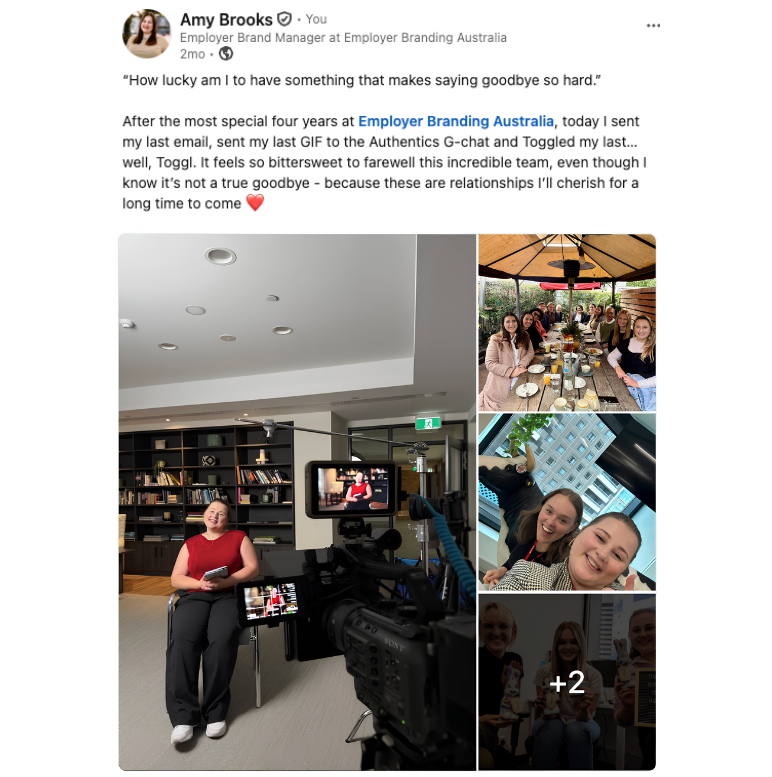
I only lasted a month before realising the grass wasn’t greener on the other side. Luckily, Employer Branding Australia welcomed me back with open arms. I want to say settling back into my role has been comfortable, like shrugging on a perfectly worn, cosy old jumper. And it has. But it’s also been completely reinvigorating. I feel excited again - to do cool things, be around cool people, and to have gained a cool story with a click-baity headline to share with all of you.
I’ve also found myself spending more time with friends, picking up new hobbies and taking care of my wellbeing. And less time on my screen.
Funny, huh? I didn’t need my feed; I needed to be fulfilled.
